A
Dots, 2″ × 2″
TF 206 mm dots on a 2″ × 2″ grid. The densest option and the best-performing. This is our default recommendation where an ordinance sets a 2″ × 2″ rule.
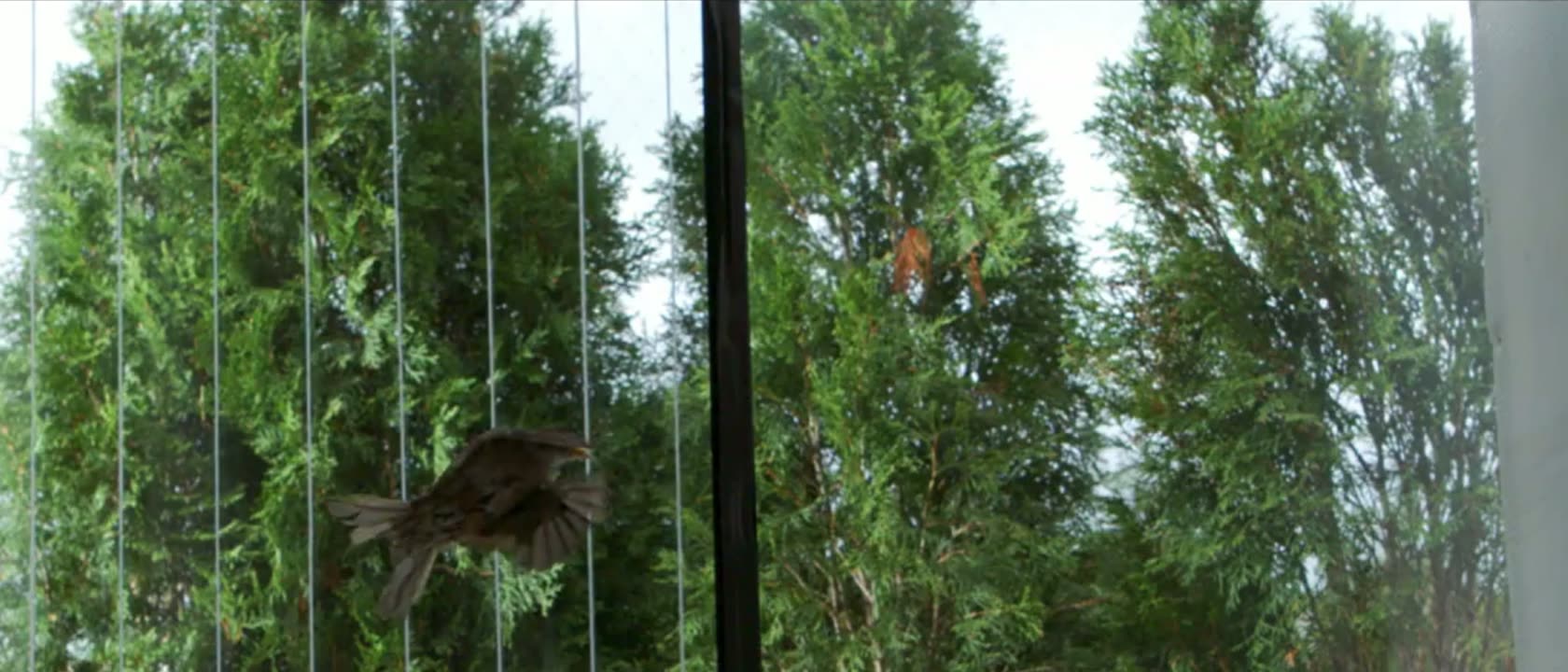
Up to a billion birds die each year in the United States after colliding with glass. Flyway is our answer: a permanent surface-1 etch, in five patterns, all approved by the American Bird Conservancy, and etched right here in Burnsville rather than shipped in from three states away.
All five Flyway patterns fall at or below a Threat Factor™ of 25.
ABC's bird-friendly threshold is 30 or lower. Lower is better.
Flyway™ Bird-Safe Glass is River City Creative Glass's line of bird-friendly architectural glass. It uses a permanent etch on surface 1 of the glass, in one of five patterns evaluated and approved by the American Bird Conservancy in August 2026. The patterns carry Threat Factors™ of 20 or 25, both well inside ABC's bird-friendly threshold of 30 or lower.
A Threat Factor™ is ABC's score for how likely birds are to collide with a given material, and lower is better. ABC considers a material bird-friendly at 30 or below, which corresponds to a conservative estimated collision reduction of at least 50% in real-world conditions. Flyway patterns A, C and E score 20; patterns B and D score 25.
Evaluated. Flyway was rated through the ABC / Bird-Safe Buildings Alliance evaluation protocol, which assigns Threat Factors™ to materials demonstrably similar to products already tunnel tested. ABC is explicit that these ratings are deliberately conservative: the assigned rating is the maximum expected Threat Factor, and a lower score may be achievable through actual tunnel testing. In other words, 20 is the ceiling, not the average.
The Bird-Safe Buildings Alliance, a group of architects experienced in bird-friendly design, conservation biologists and collision experts who partner with the American Bird Conservancy. River City Creative Glass submitted five surface-1 etch patterns. The evaluation period ran June to August 2026, and the report is dated August 26, 2026. All five samples were found to satisfy ABC's criteria for bird-friendly glass and materials.
Swatches below are drawn to actual scale. Each square is a 12″ × 12″ field of glass.
6 mm dots on a 2″ × 2″ grid. The densest option and the best-performing. This is our default recommendation where an ordinance sets a 2″ × 2″ rule.
6 mm dots on a 2″ × 4″ grid. Half the marks of Pattern A, still comfortably bird-friendly, and the most visually open of the dot patterns.
3 mm vertical lines at 2″ spacing, continuous full height. Reads as a fine reeded texture; disappears against mullion rhythm.
3 mm vertical lines at 4″ spacing. The lightest touch we offer, for facades where the glazing needs to stay as unobtrusive as possible.
3 mm horizontal lines at 2″ spacing, continuous full width. Same rating as Pattern C, with a horizontal emphasis that suits banded facades.
Dimensions, o.c. spacing, gloss readings, substrate options and IG configurations for all five patterns.
This is where the ABC approval earns its keep. The evaluation covers the etch pattern rather than one specific glass makeup, so the rating travels across substrates and unit types.
The approval explicitly covers application to any vision glass or tinted glass unit. Clear, low-iron, gray, bronze or blue, the pattern keeps its rating.
Low-E and other coatings sit behind the surface-one etch. Your thermal package is unaffected by the bird-safe layer, and vice versa.
We etch surface 1 of an IG unit built by an IGCC-certified partner such as Oldcastle, or build the unit here to whatever makeup you want.
A growing list of cities and states now mandate bird-friendly glazing on new construction and major renovations. Flyway's ratings satisfy the material threshold those codes point to.
LEED Pilot Credit 55 (Bird Collision Deterrence) uses a Bird Collision Threat Rating built on material Threat Factors. Lower-TF glazing earns a better building score.
Campuses, nature centers, corporate headquarters and homeowners with a bad window are increasingly asking for it unprompted, with no code requiring it.
Most bird-friendly glass gets specified, then ordered from a distant fabricator, then waits. We do the etching ourselves in Burnsville. That means samples in days, replacement lites without re-ordering a whole package, and someone to call when the pattern needs to shift a quarter inch to miss a mullion.
Bird-friendly glazing turns up in a section you're pricing, often late, usually with an unfamiliar product named as basis of design. Here is what we do before bid day, at no cost, and whether or not you end up using us.
Send us the glazing section. We come back with a written confirmation of whether Flyway™ meets it as written, and we name anything in that section we can't meet before you carry the number.
We supply a substitution request package: the ABC evaluation report, a Threat Factor™ comparison against the specified product, and samples for the architect to review.
Send drawings and you get back a pattern recommendation, a layout showing pattern extents and how transoms, corners and returns are handled, and a price you can carry.
Product data, samples on the actual glass makeup, the evaluation report and shop drawings, packaged to the submittal requirements in the section rather than as a pile of PDFs for you to sort out.
A full-size unit for architect review before we fabricate the balance, so a pattern question gets settled on the ground instead of after the glass is up.
Glass, etch, insulating unit and installation all from Burnsville. When something goes sideways in the field there's no finger-pointing between a fabricator, a coater and a glazier.
The etching happens in our own shop. There's no overseas order and no third-party coater sitting in your schedule, which is usually the reason bird glass scares people on a tight job.
If the design team has questions about pattern selection, Threat Factor™ or coverage, send them to us. That conversation shouldn't be your problem to manage.
Not meaningfully. The markers are 3 mm lines or 6 mm dots covering a small fraction of the glass area, and the etch reads at a gloss of < 6 at 60°, a soft matte marking rather than an opaque obstruction. In practice occupants notice the pattern for about a week and then stop seeing it. Birds, whose vision works differently, continue to read the glass as a solid surface.
Surface 1, the outermost exterior face. Markers on interior surfaces get washed out by exterior reflection, which is the exact condition that causes most collisions. All five Flyway patterns are approved specifically as surface-1 applications, with any coatings placed behind the etch.
The pattern is abraded into the glass, not applied on top of it. There is no film to peel, no ink to fade and no coating to delaminate. It cleans with ordinary glass cleaner and a soft cloth, and it will outlast most of the building around it.
Grid spacing. Pattern A places 6 mm dots on a 2″ × 2″ grid (Threat Factor 20); Pattern B stretches the horizontal spacing to 4″ for a 2″ × 4″ grid (Threat Factor 25). B uses half as many marks and reads as more open glass. Both qualify as bird-friendly; choose A when an ordinance specifies a 2″ × 2″ rule or when you want the strongest possible number.
Often, yes, but only the five evaluated patterns carry an assigned Threat Factor™. If you need a custom layout we can produce it, and we'll tell you whether it still falls within the geometry ABC evaluated or whether it becomes an unrated pattern.
Yes. It is the same product at a smaller scale, and it is a genuine fix for a picture window or patio door that keeps killing birds. Call the shop and we'll talk through whether etching the existing glass or replacing the lite makes more sense.
Ask. We'll send a sample kit with the patterns you're considering so you can hold them up to daylight, which is the only way to judge them. Request a sample kit →
Send us an elevation and we'll come back with a pattern recommendation, a layout and a number.